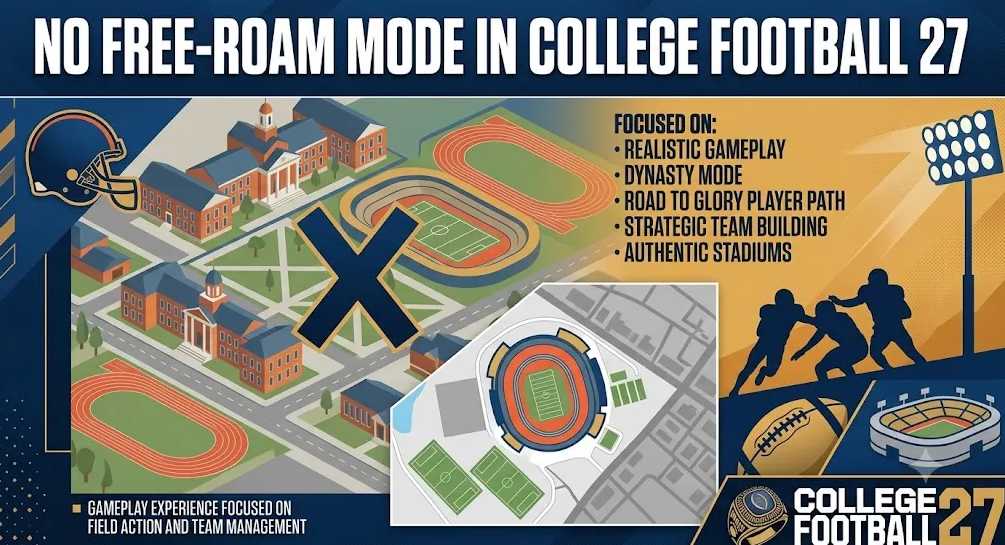

The absence of an open-world "Free-Roam Mode" in EA Sports College Football 27 represents a massive missed opportunity to deliver the ultimate student-athlete role-playing experience. While EA has drastically overhauled the menus and underlying systems for its Road to Glory career mode, the choice to keep the player experience locked behind text boxes and menu screens completely underutilizes the unique, vibrant cultural pageantry that separates college football from the pros.
The decision by EA Sports to leave a fully explorable campus on the cutting-room floor feels like a major misstep for several distinct reasons.
1. It Fails to Capture the "Campus Culture"
College football is defined by its environmentthe historic campus quads, the iconic tailgating areas, and the local landmarks that make every school unique. A menu-based system completely sterilizes this atmosphere. Instead of interacting with fans on the quad, walking through a faithfully recreated campus before a rivalry game, or visiting famous local spots to build a personal brand, players are left selecting options on a text-heavy weekly agenda screen. It strips away the soul of the college experience and reduces it to a spreadsheet simulator.
2. It Stifles the Modern NIL Narrative
In the modern Name, Image, and Likeness (NIL) era, a player's off-field presence is almost as crucial as their on-field production. A free-roam mode would have been the perfect vehicle to modernize Road to Glory into a true football RPG. Players could have experienced a much more interactive journey:
Walking directly into local booster meetings or car dealerships to sign high-stakes NIL deals.
Visiting the campus bookstore to see their own custom apparel sitting on the shelves.
Interacting directly with classmates and professors to manage the crucial, delicate balance of academic standing and locker room reputation.
Turning these dynamic, high-stakes real-world interactions into static menu clicks strips the mode of its realism and emotional investment, separating the gamer from the actual lifestyle of a modern athlete.
3. Missing a Competitive Evolution in Sports Gaming
Other sports titles have proven that immersive hub worlds drastically increase player engagement. EAs own sister franchise, EA Sports FC 27, heavily leaned into open-world concepts with its "The Grounds" mode, while the NBA 2K franchise has long utilized its walkable "City" to keep career modes fresh. By failing to introduce a campus-based equivalent, College Football 27 risks looking visually outdated and developmentally stagnant compared to its contemporaries, lagging behind the standard set by other major sports titles.
4. Viral Fan Interest Proves the Demand
The immediate backlash to the missing mode stems from a viral wave of fan-generated, AI-assisted concept videosincluding a hyper-realistic mockup from the West Virginia Football official accountdepicting a stunning, open-world Morgantown. The explosive popularity of these concepts proved that the community desperately craves a living, breathing college universe. The hype was real, the vision was clear, and the demand was explicitly proven before the game even hit shelves.
The Counter-Perspective: A Necessary Sacrifice?
While the community is understandably disappointed, the decision to leave out free-roam likely saved the game from a different disaster. Authentically scaling and rendering over 134 unique, highly detailed college campuses would be a logistical and technical nightmare for a yearly release cycle. Furthermore, looking at the NBA 2K model, open worlds often bring tedious "fetch quests" (like running across a massive map just to talk to a coach) and aggressive microtransactions.
By bypassing the open world, EA was able to focus its resources on deep mechanical overhauls, such as introducing the Edge, Tight End, and Free Safety positions to Road to Glory, a rewritten AI movement system, and an incredibly deep, point-based Dynasty Blueprint system for program building.
Ultimately, College Football 27 chooses to be an incredibly sharp, high-IQ simulation of football gameplay and program management. However, by locking the player behind a flat user interface, it misses the chance to become the definitive, highly immersive college lifestyle simulator fans have dreamed of for over a decade. It is a brilliant football game, but it falls short of being the ultimate college experience.





